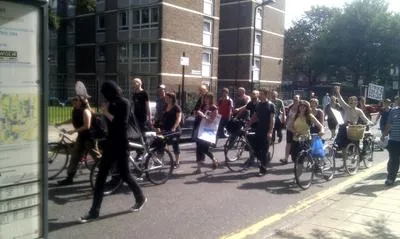
North London was alive with the sound of pickets yesterday, as hundreds of people around the boroughs stood outside their workplaces to take on bosses and persuade workmates not to cross the line. Focussing on the particularly vibrant borough of Hackney, North London Solfed can report a strong showing from the places we visited, with scabbing kept to a minimum - though sadly not every staffer had worked out that it's worse for kids to have badly-treated teachers than for them to miss a day of school.
Bridge Academy
Several Solfed members started out at Bridge Academy, the only one of the network of controversial semi-privatised schools to actually close down entirely, for its 7am picket. The building on Laburnum Street has seen increasing anger within the staff as teaching standards are attacked and pensions has piled on top of that. Picketers were backed by around a dozen early-risers who had come out in support.
The past week has seen NLSF participate in two “distros”: handing out fliers, badges, and stickers in support of June 30th's public sector strike and giving out free copies of SolFed's national newspaper Catalyst.
Although we certainly hope to attract like-minded militants to our organisation, the overriding aims were practical: to promote the upcoming strike, inform the public of practical ways to participate and show support, to counter the government and media spin about the strike, and to argue for militant, self-organised acts of solidarity and struggle from across the working class. To this end, we gave out various fliers (see the right-hand side of NLSF webpage) and copies of the newest issue of Catalyst. When interested individuals stopped for a chat, we gladly offered them “Don't Work June 30th” stickers and various anti-cuts badges.
In preparation for the upcoming June 30th strike, yesterday saw the North London Solidarity Federation host an organiser training specifically designed for workers and students in the education industry.
Coming out of a public meeting hosted by NLSF last month, militant education workers and radical students opted to have a training geared toward their specific issues. For SF it was the first time we attempted to tailor our training for students and all agreed it was a success. While the issues varied from participant to participant—from making sure June 30th is a success to planning occupations—everyone left the training with an increased sense of confidence and strategy to take back to their schools on Monday morning.