Home
Solidarity Federation
IWA
User account menu
  • Contact
  • Log in
  • Home
    • Intro
    • Workplace organiser training
    • Industrial strategy
    • Community strategy
    • Constitution
  • SolFed
    • Brighton
    • Bristol
    • Edinburgh
    • Liverpool
    • Manchester
    • North London
    • Wales
    • Yorkshire
  • Industries & sectors
    • Claimants and unpaid
    • Education
    • Health and social care
    • Hospitality
  • Events & reports
  • Publications
    • Guides
      • Stuff your boss (doesn't want you to know)
      • Stuff your sexist boss (doesn't want you to know) (2018)
      • Stuff your landlord (doesn't want you to know) (2016)
      • Is your cleaning job killing you? A guide to cleaners health and safety (2017)
      • Office worker’s health and safety - your rights and how to use them (2015)
      • A migrant's guide to Manchester (2016) [en es]
      • A migrant's guide to London (2014) [en es pl]
      • Strike - a guide to walking out (2014)
    • Pamphlets and books
      • Anarcho-syndicalism in Britain – a little history (2015)
        • 1. 19th century to 1914 - The First International, growth of industrial unionism and the Great Unrest
        • 2. 1914–1945 - State suppression and the Bolshevik turn – how Lenin’s seeming success drew militants to the Comintern
        • 3. 1945–1994 - The Anarchist Federation of Britain, Syndicalist Workers’ Federation and Direct Action Movement
        • 4. Today’s movement - A short look at the strategy and thinking of the modern Solidarity Federation
      • Office worker’s health and safety - your rights and how to use them (2015)
      • Anarchism and Anarcho-syndicalism (Rudolf Rocker, 2014)
        • Introduction
        • 1. Ideology of Anarchism
        • 2. History of anarchist philosphy, from Lao-Tse to Kropotkin
        • 3. The origins of anarcho-syndicalism
        • 4. Socialism and anarcho-syndicalism in France
        • 5. The role of the trade unions: anarcho-syndicalist view
        • 6. The struggle in Germany and Spain
        • 7. The political struggle: anarcho-syndicalist view
        • 8. Anarcho-syndicalism since the First World War
      • Fighting for ourselves - anarcho-syndicalism and the class struggle (2012)
        • Introduction
        • 1. The mainstream workers' movement
        • 2. Radical currents in the workers' movement
        • 3. Anarcho-syndicalism in the 20th century
        • 4. Capitalism and the class struggle since World War II
        • 5. Anarcho-syndicalism in the 21st century
        • Endnotes
      • Workmates - direct action workplace organising on the London underground (2011)
      • The Economics of freedom (2003)
      • A history of anarcho-syndicalism (2001)
      • Out of the frying pan, a critical look at works councils (1998)
      • Health and safety at work - an anarcho-syndicalist approach (1997)
      • Anarcho-syndicalism in Puerto Real (1994)
    • Leaflets and flyers
      • Solidarity Federation Education Union (SFEU)
      • Solidarity Federation Hospitality Workers Union (SFHWU)
      • Why do we organise?
      • This is our flag - it tells you what we stand for
      • What is anarcho-syndicalism anyway?
      • Anarchism and Syndicalism (short version)
      • Anarchism and Syndicalism
      • Towards a better union
      • Protest is not enough
      • Building beyond elections
      • We should run our workplaces
      • We should run our communities
      • We should run our movements
    • Newsletters
      • Brighton Solidarity
        • Brighton Solidarity #3
      • Education Worker
        • Education Worker #10 Victimisation (2013)
        • Education Worker #9 (2012)
        • Education Worker #8 Academy Special (2012)
      • Wildcat!
        • Wildcat! #13 (Jan 2013)
        • Wildcat! (Winter 2012)
        • Wildcat! #6 (Summer 2011)
        • Wildcat! #5 (Spring 2011)
        • Wildcat! #4 (Dec 2010)
        • Wildcat! #3 (Oct-Nov 2010)
        • Wildcat! #2 (Jul-Aug 2010)
        • Wildcat! Football for the fans NOT for fat cats! (Jul 2010)
        • Wildcat! #1 (May-June 2010)
      • May Day Bulletin (Newcastle SolFed, 2014)
    • Direct Action
      • Direct Action #2 (2024)
      • Direct Action #1 (2023)
      • Direct action #48 (Autumn 2009)
      • Direct action #47 (Summer 2009)
      • Direct Action #46 (Spring 2009)
      • Direct Action #45 (Winter 2008)
    • Catalyst
      • Catalyst #29 (Feb 2012)
      • Catalyst #28 (Oct 2011)
      • Catalyst #27 (Jun 2011)
      • Catalyst #26 (Mar 2011)
      • Catalyst #25 (Dec 2010)
      • Catalyst #24 (Summer 2010)
    • SelfEd
      • A history of anarcho-syndicalism
        • Block 1
          • Unit 1: The Origins of Capitalism
          • Unit 2: Britain: The Radical Period 1750-1840
          • Unit 3: The First International
          • Unit 4: France 1870-1918 Early revolutionary unions
          • Unit 5: Revolutionary Syndicalism in Britain, 1870-1910
          • Unit 6: Revolutionary Syndicalism in Britain and Ireland, 1910-17
        • Block 2
          • Unit 7: Mexico 1870-1920: Colonialism and Revolution
          • Unit 8: USA 1886-1930 - The Wobblies
          • Unit 9: Anarcho-syndicalism in Argentina 1870-1939
          • Unit 10: Sweden 1889-1939
          • Unit 11: Russia I: 1850-1917
          • Unit 12 Russia II: 1917-30
        • Block 3
          • Unit 13: Going Global - International Organisation, 1872-1922
          • Unit 14: Anarcho-syndicalism in Britain, 1914-30
          • Unit 15 Spain, 1868-1936: Build-up to Revolution
          • Unit 16 Spain: Culture, education, women and sexuality
          • Unit 17: Spain 1936-39: Revolution and Civil War
          • Unit 18: Spain - The Collectives
        • Block 4
          • Unit 19: Britain, 1930-1950 - The Era of Reform
          • Unit 20: Britain, 1950-1990 - Decline of Social Democracy
          • Unit 21: anarcho-syndicalism 1939-99
          • Unit 22: Roots of modern anarcho-syndicalism: freedom, oppression & rebellion
          • Unit 23: Roots of modern anarcho-syndicalism: morality, culture & tactics
          • Unit 24: The spirit of anarcho-syndicalism
    • Letters
  • IWA

Breadcrumb

  1. Home
  2. industries, occupations and sectors

claimants and unpaid

By Joseph Kay, 2 March, 2012

Factsheet: 5 kinds of workfare

Currently there are currently five workfare schemes in use in the UK, below we explain them

  • The Work Programme: Coalition’s flagship workfare scheme which replaced Labour’s Flexible New Deal in summer 2011. Claimants are referred to private companies who can organise mandatory unpaid work placements for as long as six months. Refusal means loss of benefits.
     
  • Mandatory Work Activity: The Job Centre can order claimants to work up to 30hrs a week for a period of four weeks without pay. Refusal to comply means loss of benefits.
Tags

  • workfare
  • claimants and unpaid
By www, 24 February, 2012
c

Know Your Rights: Redundancy

The Chartered Institute of Personnel and Development have predicted that 725,000 public sector jobs and up to 900,000 private sector jobs will go in the next five years, as a result of spending cuts and the VAT increase. While some will go through retirement and natural wastage, a lot more workers will be facing redundancy. Here is a brief guide to the law around it.

Redundancy happens when an employer ceases to carry on its business, or stops or diminishes some part of its business. The law covers England, Scotland and Wales, with different legislation in Northern Ireland, though its provisions are similar.

For a worker to be made redundant, their dismissal has to be attributable to the reduction in employees. It doesn’t need to be motivated by a company in difficulties, any reorganisation that results in fewer staff will be a redundancy.

Tags

  • Know your rights
  • employment rights
  • claimants and unpaid
By Joseph Kay, 23 February, 2012
c

The logic of workfare

Workfare means unemployed people being forced to do unpaid work for their benefits. Tens of thousands of people are being forced into unpaid work, household name firms are profiting from free labour and disabled people face unlimited unpaid work or cuts in benefit. Workfare began under Labour with the New Deal in 1998, which became the Flexible New Deal in 2009. It is now being expanded by the Conservative-Liberal government under a number of different schemes including: ‘Work Experience’, ‘Mandatory Work Activity’, ‘the Community Action Programme’, ‘Sector Based Work Academies’, and ‘the Work Programme’.

Tags

  • benefits
  • workfare
  • claimants and unpaid
By Joseph Kay, 21 February, 2012
c

Know your rights: failing a Work Capability Assessment

What to do if you 'fail' your work capability assessment

Some brief advice on the process of appealing a failed Work Capability Assessment (WCA), as well as some signposting to relevant advice bodies who may be able to assist you.

When you first receive the results of your ATOS WCA and it is a fail, the first thing that many do, as they are panicked and desperate, as they have had their money stopped, is to panic and phone the Job Centre Plus and ask about signing on for Jobseekers Allowance, which is what they want you to do, but there is an alternative and that is by asking for a reconsideration and/or appeal.

How to request reconsideration/appeal

Tags

  • leaflets and flyers
  • claimants and unpaid
By Joseph Kay, 21 February, 2012
c

What to do if you 'fail' your work capability assessment

Know your rights!

Some brief advice on the process of appealing a failed Work Capability Assessment (WCA), as well as some signposting to relevant advice bodies who may be able to assist you.

When you first receive the results of your ATOS WCA and it is a fail, the first thing that many do, as they are panicked and desperate, as they have had their money stopped, is to panic and phone the Job Centre Plus and ask about signing on for Jobseekers Allowance, which is what they want you to do, but there is an alternative and that is by asking for a reconsideration and/or appeal.

How to request reconsideration/appeal

Many claimants have found they have scored “0” points in their WCA and thus their benefits have been suspended. As the suspension notice usually arrives on or after the claimants usual pay day, panic ensues, followed by a call to Job Centre Plus and advice from Job Centre Plus to sign on for Job Seekers Allowance.

Tags

  • ATOS Origin
  • Know your rights
  • ESA
  • job centres
  • unemployment
  • practical advice
  • claimants and unpaid
By m.a.j., 17 November, 2011

Unpaid Labour in the South East

Courtesy of our friends at the Brighton Benefits Campaign, what follows is a list of companies in Kent, Surrey and Sussex that have taken advantage of mandatory work placements through the Government’s Work Programme in which unemployed people are forced to work without pay. The placements are arranged by a private company called Avanta Enterprise Limited:

Tags

  • benefits
  • welfare
  • workfare
  • claimants and unpaid
By Mons, 8 November, 2011

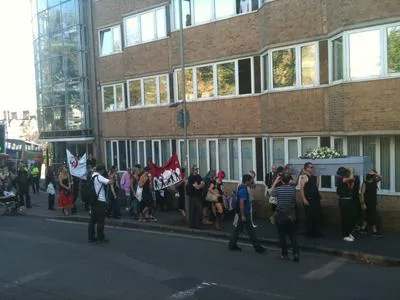
Students to Sparks: Join Us!

bWe’ve seen cuts to education, leading to the destruction of EMA, tripled uni fees, mass redundancies and course closures. We’re now witnessing – if we fail to stand up and beat it – the virtual privatisation of education. But the government’s austerity measures are not just attacking education – pensioners, the unemployed, workers in all industries in both public and private sector are all facing massive cuts – leaving no-one spared!

Tags

  • demonstrations
  • electricians
  • job cuts
  • students
  • claimants and unpaid
  • education
By Joseph Kay, 1 October, 2011

National day of action against ATOS

ATOS healthcare are the private IT company tasked with kicking sick and disabled claimants off benefits by classifying them as fit to work using an automated program. The Brighton Benefits Campaign and Disabled People Against Cuts organised the local contribution to the national day of action against ATOS, which saw around 25 people assemble in Brighton, street theatre depicting the computerised 'fit for work' assessment and a short march to the nearby ATOS building.

Tags

  • benefits
  • claimants and unpaid
  • demonstrations
  • disability
By Joseph Kay, 29 June, 2011
c

Leaflet: The Stuff Your New Deal Office doesn't want you to know

Download as a pdf here.

Tags

  • benefits
  • employment rights
  • claimants and unpaid
By Joseph Kay, 28 June, 2011

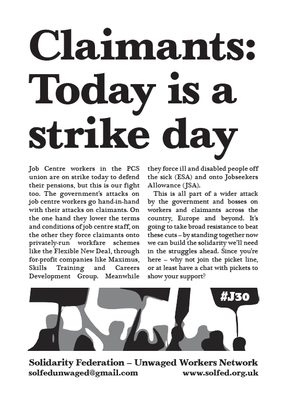
Claimants - today is a strike day

UWNDownload the pdf here.

Job Centre workers in the PCS union are on strike today to defend their pensions, but this is our fight too. The government’s attacks on job centre workers go hand-in-hand with their attacks on claimants. On the one hand they lower the terms and conditions of job centre staff, on the other they force claimants onto privately-run workfare schemes like the Flexible New Deal, through for-profit companies like Maximus, Skills Training and Careers Development Group. Meanwhile they force ill and disabled people off the sick (ESA) and onto Jobseekers Allowance (JSA).

Tags

  • ESA
  • job centres
  • Public and Commercial Services Union (PCS)
  • solidarity
  • strikes
  • claimants and unpaid
  • Unwaged Workers Network (UWN)

Pagination

  • First page
  • Previous page
  • Page 1
  • Page 2
  • Page 3
  • Page 4
  • Page 5
  • Next page
  • Last page
claimants and unpaid

Guides

Your rights at work

Why do we organise? Capitalism is shit, oppression is shit - but what can we at SolFed do about it?

Why do we organise?

This is our flag - it tells you what we stand for

this-is-our-flag

Direct Action #2 (2024)

Direct Action #2 (2024)

Anarcho-syndicalism in Britain – a little history (2015)

Anarcho-syndicalism in Britain – a little history (2015)

Office worker’s health and safety - your rights and how to use them (2015)

Office worker’s health and safety - your rights and how to use them (2015)

Anarchism and Anarcho-syndicalism (Rudolf Rocker, 2014)

Anarchism and Anarcho-syndicalism (Rudolf Rocker, 2014)

Fighting for ourselves - anarcho-syndicalism and the class struggle (2012)

Fighting for ourselves - anarcho-syndicalism and the class struggle (2012)

Theory & Practice 1 - Workmates - direct action workplace organising on the London underground (2011)

Theory & Practice 1 - Workmates - direct action workplace organising on the London underground (2011)

The Economics of freedom (2003)

The Economics of freedom (2003)

A history of anarcho-syndicalism (SelfEd Collective, 24 unit series, 2001)

A history of anarcho-syndicalism (SelfEd Collective, 24 unit series, 2001)

Out of the frying pan, a critical look at works councils (1998)

Out of the frying pan, a critical look at works councils (1998)

Health and safety at work - an anarcho-syndicalist approach (1997)

Health and safety at work - an anarcho-syndicalist approach (1997)

Theory & Practice 2 - Anarcho-syndicalism in Puerto Real (1994)

Theory & Practice 2 - Anarcho-syndicalism in Puerto Real (1994)
RSS feed