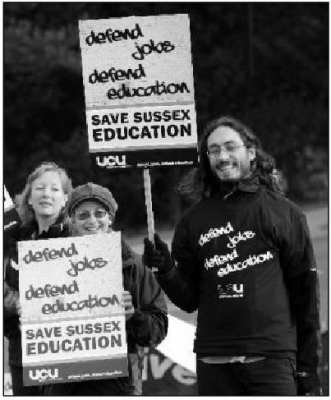
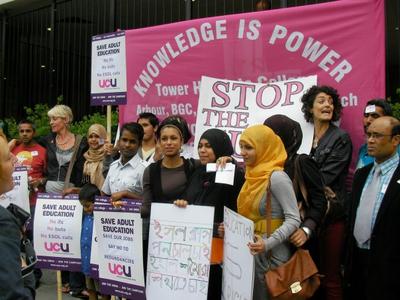
Lecturers, academics, researchers and support staff from AUT and NATFHE unions staged a one day strike on March 7th. This national day of action also marked the start of an indefinite "action short of a strike" including boycotts of assessments, appraisals and staff cover.The action had been supported by students from the NUS as well.
Universities and colleges across the country had lectures cancelled and many universities saw good levels of attendance among unionised members. The best turnout was reported in some of the Scottish universities where almost all lectures were cancelled and most
Higher Education faces significant changes in the coming years as universities move to a market based model. Tuition and top-up fees are perhaps the more visible signs of this but many institutions are now seeing changes which, among other things, significantly affect education workers’ terms and conditions. Union responses so far have seen conferences like NUS’s (National Union of Students) ‘Reclaim the Campus’ and UCU’s ‘Challenging the market in education’ (University and College Union)
Meanwhile, the more action-minded have been far from quiet. The Universities of Sussex and Manchester, for
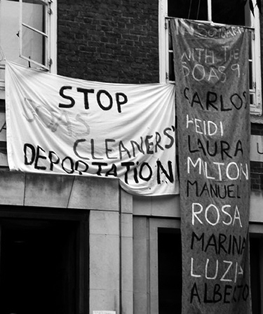
At the London School of Economics the cleaning contract is held by ISS, a multinational with lots of privatised cleaning contracts, including the London Underground. The cleaners are mainly Latin American with poor English and a fear of joining a union or speaking out about their lousy pay and conditions.
As a result of a campaign by Justice for Cleaners, the LSE has adopted the London Living Wage which is higher than the National Minimum Wage. However, it was phased in over three years of the new cleaning contract.
Worse, the workers are paying for it. They are currently paid £6 per hour but
Since 23rd April parents of pupils at Lewisham Bridge Primary School in Lewisham, south east London, and their supporters have been occupying a school roof. They are protesting against Lewisham Council’s plans to demolish the school building and replace it with a school for children aged 3 to16. The proposed new school will be squeezed into a site presently occupied by the primary school, which has less than half of the 835 pupils projected for the “all age” school, so play areas and room sizes would fall below government recommendations.
The new school would only have one primary class per
Manchester College, the largest FE college in the UK is bent on breaking its UCU (Universities & Colleges Union) branch. Despite promises on job security after merger and with no attempt to negotiate voluntary redundancy or redeployment, bosses announced in June that 13 teaching posts were to be cut. The fact that the UCU secretary’s post is among the first to go clearly signals management’s intent.
A strike ballot gained 74% backing and a one day strike ensued on July 1st. There were pickets at all of the college’s sites across the city, with Manchester EWN-SF (Education Workers’ Network)
On June 12th, cleaners working for ISS at the School of Oriental & African Studies (SOAS) in London were called to a meeting by management. The cleaners were “processed” by immigration officials who detained nine of them as “illegal immigrants”. It was perhaps no coincidence that a picket of SOAS’ governing body demanding the reinstatement of victimised SOAS UNISON Branch Chair José Stalin Bermudez, who had been prominent in organising cleaners, had been called for that morning.
Those detained were denied union representation, but a campaign was quickly organised by SOAS campus unions and
The academics’ union UCU at the University of Sussex cancelled industrial action planned for late June after university bosses declared they were “hopeful” they could avoid any compulsory redundancies.
It soon emerged however that compulsory redundancies had been transformed into ‘voluntary’ ones and the number of job losses remained at over 100, with a similarly severe impact on many courses and workloads expected.
One student mocked the management statement: “We are pleased to announce that the 100 have jumped, and were not pushed. The knives to their backs were unrelated.” A lecturer also
A new Education Bill is set to massively extend Labour’s controversial Academies programme.
The Education Secretary Michael Gove has now added Ofsted-graded “outstanding” schools to the hit-list. His plans promise even more Academies; over 150 schools have already applied for Academy status, with hundreds more enquiring for further information or registering an interest. The Academies scheme allows non-state bodies, including religious groups, businesses and voluntary groups to take control of schools in exchange for a nominal amount of funding for new facilities.
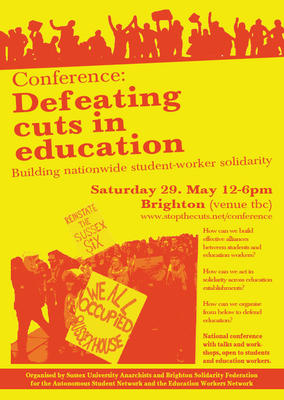
THIS Saturday (29th May), 12pm – 6pm in Brighton. Join the Facebook event. Venue to be confirmed very soon here and on Facebook.
As a new government is getting ready to attack the living conditions of ordinary people, students and education workers have already had experiences with cuts – and how we can stop them. We will try to draw the lessons from the strikes, occupations and other forms of direct action taken in HE and FE over the last months. How can we build effective alliances between students and workers? How can we act in solidarity across education establishments? How can we organise
While the recent media spin is suggesting that we’re ‘on our way out of recession’, the reality on the ground is that workers are still facing attacks across sectors in the forms of job cuts and community provisions. Education has been one of the sectors worst hit in this period, with £65m slashed from higher-education (HE) budgets, schools closing left, right and centre, and jobs to go at approximately 100 of the 150 HE institutions in the UK . The situation is as bleak as ever.
In August, around 250 members of teaching staff at Tower Hamlets College (THC), East London went on indefinite