sfeu.svg
The Solidarity Federation Education Union (SFEU), welcomes the news that workers in Further and Higher education have voted to take strike action on pay and pensions. On both counts, the voting threshold was attained (some 84.9% in favour with a 60.2% turnout for strikes over pension cuts and 81.1% in favour with a 57.7% turnout on real term pay cuts).
 WHAT IS GOING ON?
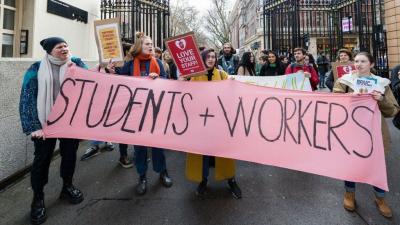
  Starting on Wednesday 1st December, 58 branches of UCU (University and College Union) went on strike for 3 days over issues surrounding pensions, pay, working conditions and pay gaps. A group of SolFed members who are students at Sussex University attended the picket line and took part in direct action in support of all staff who were on strike.
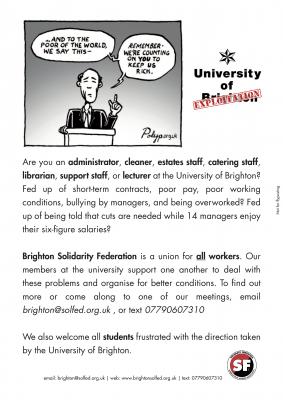 Working conditions in educational institutions are becoming more and more difficult. This is often linked to managers making cuts, establishing austerity measures, or asking all workers to do more for less. We currently organise as a network of workers at University of Brighton, and have links to other educational institutions.
 Five years ago, “zero hours” contracts came to the attention of the national media. While there is no one type of “zero hours” contract, in all cases workers receive no guaranteed weekly hours or income. Workers are paid only for the actual hours worked, and the employer is under no obligation to provide any work. Their use by employers in very many sectors of the British economy has mushroomed in recent years. In 2006, possibly 0.5% of the workforce had “zero hours” contracts (130,000). According to the Labour Force Survey, 901,000 people (representing 2.8% of all workers) were on contracts that do not guarantee work in December 2017.