The University and College Union (UCU) is now in its third week of strike action over pensions, pay, equality issues, workload and casualization of the sector. Although developments are being kept pretty much in secret, branches have pressed the Union leadership for an open discussion and ratification of any agreements that we may collectively come to. Some branches have also been discussing what the next step could entail if there is insufficient progress. While the sector does not have a huge amount of power in some senses, unless railway unions or NHS workers, universities are increasingly
We are in the midst of the country’s biggest university strike ever in a dispute over pensions and the “four fights” of equality, pay, workload and casualization. On the last front, in some universities, there are up to 70% of lecturers who are on hourly paid or fixed term contracts. These are convenient for universities in what has grown to be a highly casualized sector but provide no security for workers who have often trained for up to ten years in their chosen subject. The representation of women and BME workers is also a key issue that the University and College Union is seeking action on
Working conditions in educational institutions are becoming more and more difficult. This is often linked to managers making cuts, establishing austerity measures, or asking all workers to do more for less. We currently organise as a network of workers at University of Brighton, and have links to other educational institutions.
We aim to organise to improve these conditions on a day-to-day basis, trying to fight winnable disputes for caretakers, cleaners and hourly-paid lecturers alike. To resist the ways that these institutions are attacking the working conditions of all staff means working
Five years ago, “zero hours” contracts came to the attention of the national media. While there is no one type of “zero hours” contract, in all cases workers receive no guaranteed weekly hours or income. Workers are paid only for the actual hours worked, and the employer is under no obligation to provide any work. Their use by employers in very many sectors of the British economy has mushroomed in recent years. In 2006, possibly 0.5% of the workforce had “zero hours” contracts (130,000). According to the Labour Force Survey, 901,000 people (representing 2.8% of all workers) were on contracts
In the coming days lecturers from 61 universities across the country are going on strike. In Liverpool, the UoL and the School of Tropical Medicine will be affected.
The strike action, called out by UCU, is in response to the newest attack to their working conditions. This time is about the pensions.
Lecturers are faced with the proposal of much less security in retirement. Currently, they are aware of the amount of money they will receive from their pension when they retire. It is being proposed that this will change and will instead be based on investments of their pension contributions. This
Cleaners have a vital role in society, yet their job is poorly paid and routinely dismissed as a job carried out mainly by women to earn a bit of extra cash. Cleaning is also not generally seen as a particularly physically hard or dangerous job. Most people see cleaning as involving a bit of dusting, mopping and hoovering.
Written by a cleaner, this pamphlet draws on research from across the world to show the reality of cleaning and the impact the job has on the health and wellbeing of cleaners. The pamphlet not only examines the more obvious aspects of the job that affect cleaners’ health, such as the physical demands of the job and the effects of cleaning chemicals, but also takes into account the detrimental impact of factors such as low pay, ever- increasing workloads, low status, sexual harassment and family commitments on the everyday lives of cleaners. In doing so, the pamphlet exposes the true cost being paid by cleaners and their families for job that is central to the wellbeing of society as a whole.
As such, this pamphlet is not only essential reading for cleaners but for all those interested in seeing greater justice for one of the most exploited and marginalised groups of workers.
Introduction
Background to the UK Cleaning Industry
The Real Risks to Cleaners’ Health - Work-Related Stress | Musculoskeletal Disorders | Work-Related Asthma | Skin Diseases | Accidents at Work | Biological Hazards | Heat Stress | Cancer and Risk to the Reproductive System | Sexual Harassment and Assault | Violence and Discrimination | Overall Impact of Cleaning on Health
South London Solidarity Federation would like to express solidarity with members of the Mexican Coordinadora Nacional de Trabajadores de la Educacion teaching union, who have faced violent attack by the police and state.
The union, which is made up of teachers from the poorer southern states, is protesting new mandated teacher evaluations. These it describes as ignoring the challenges of providing education in rural and underfunded areas whilst also enabling mass teacher layoffs. This is part of a wider programme of privatisation across Mexican education, removing the limited educational
Brighton Solidarity Federation Supports Demonstration Against Closure of Brighton University's Hastings Campus
The University of Brighton wants to close its campus in Hastings. The closure of the campus would likely mean job losses, and it would be damaging to the town, and to access to Higher Education in the town and surrounding area. Brighton Solidarity Federation will be supporting the demonstration against the closure of the campus this Wednesday 13th April, meeting at the Level at 1pm.
On Friday 18th March, members of Solfed informed parents of Dartford Primary Academy, part of the Leigh Academies Trust, about the ongoing campaign to get Lydia’s wages back. Lydia worked for Kinder Sports, who are contracted by Leigh Academies Trust to provide Physical Education lessons and after school sports coaching. Lydia worked for Kinder Sports for 30 hours between 6th and 30th of October 2015 (including at Dartford Primary Academy) however she has not been paid for this work. We are supporting Lydia in demanding Kinder Sports pay her the full £360 she is owed.
Lydia worked 30 hours for Kinder Sports between the 6th and 22nd of October. Kinder Sports have repeatedly tried to weasel out of paying Lydia fairly and promptly for the work she undertook for them.
Lydia and South London Solidarity Federation are now calling for a communications blockade on Twitter against Kinder Sports for unpaid wages. Kinder Sports, run by Matt Longhurst, provide after-school sports activities and some school hours provision at locations around Dartford in Kent.
Lydia began working for Kinder Sports on October the 6th as a sports coach for children. The nature of the work
 The University and College Union (UCU) is now in its third week of strike action over pensions, pay, equality issues, workload and casualization of the sector. Although developments are being kept pretty much in secret, branches have pressed the Union leadership for an open discussion and ratification of any agreements that we may collectively come to. Some branches have also been discussing what the next step could entail if there is insufficient progress. While the sector does not have a huge amount of power in some senses, unless railway unions or NHS workers, universities are increasingly
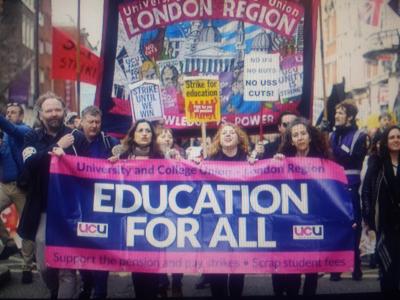 We are in the midst of the country’s biggest university strike ever in a dispute over pensions and the “four fights” of equality, pay, workload and casualization. On the last front, in some universities, there are up to 70% of lecturers who are on hourly paid or fixed term contracts. These are convenient for universities in what has grown to be a highly casualized sector but provide no security for workers who have often trained for up to ten years in their chosen subject. The representation of women and BME workers is also a key issue that the University and College Union is seeking action on
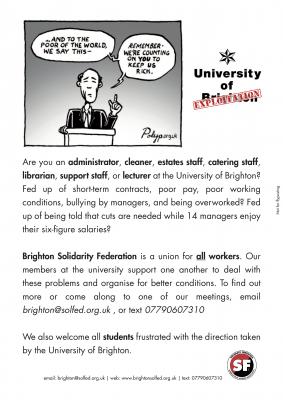 Working conditions in educational institutions are becoming more and more difficult. This is often linked to managers making cuts, establishing austerity measures, or asking all workers to do more for less. We currently organise as a network of workers at University of Brighton, and have links to other educational institutions.
 Five years ago, “zero hours” contracts came to the attention of the national media. While there is no one type of “zero hours” contract, in all cases workers receive no guaranteed weekly hours or income. Workers are paid only for the actual hours worked, and the employer is under no obligation to provide any work. Their use by employers in very many sectors of the British economy has mushroomed in recent years. In 2006, possibly 0.5% of the workforce had “zero hours” contracts (130,000). According to the Labour Force Survey, 901,000 people (representing 2.8% of all workers) were on contracts
 In the coming days lecturers from 61 universities across the country are going on strike. In Liverpool, the UoL and the School of Tropical Medicine will be affected.

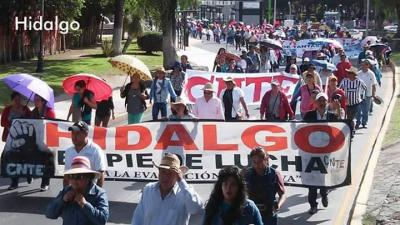 South London Solidarity Federation would like to express solidarity with members of the Mexican Coordinadora Nacional de Trabajadores de la Educacion teaching union, who have faced violent attack by the police and state.
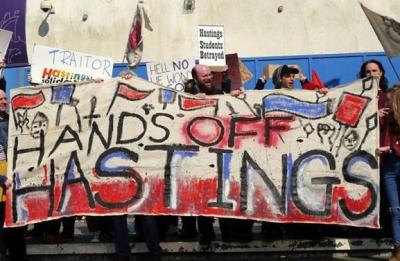 Brighton Solidarity Federation Supports Demonstration Against Closure of Brighton University's Hastings Campus
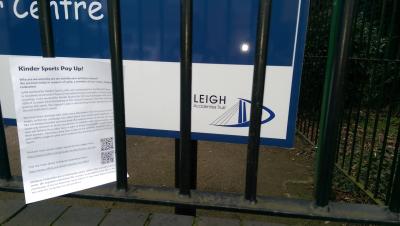 On Friday 18th March, members of Solfed informed parents of Dartford Primary Academy, part of the Leigh Academies Trust, about the ongoing
 Lydia worked 30 hours for Kinder Sports between the 6th and 22nd of October. Kinder Sports have repeatedly tried to weasel out of paying Lydia fairly and promptly for the work she undertook for them.