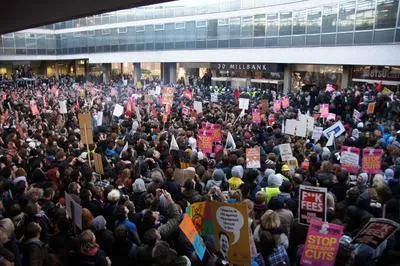
Students walking out on 24th November should avoid being trapped outside the Lib Dem HQ, says one of the groups behind the Radical Workers and Students Bloc on the 10th November demonstration. Instead, according to South London's branch of the anarcho-syndicalist Solidarity Federation, those taking action on this day should hold roaming marches blockading general economic targets.
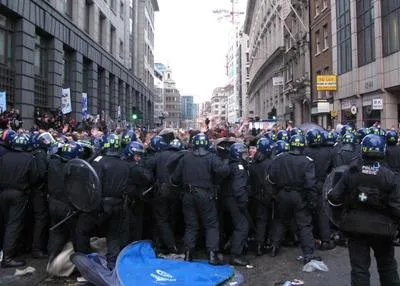
By attempting to occupy the Liberal Democrat HQ, students and workers are likely to be confronted by a much greater show of police force than was encountered at Millbank Tower. The Metropolitan police were left red faced by the trashing of the building containing Conservative Party HQ and will be looking to ensure that those events are not repeated. Anyone going there risks being kettled and quite possibly feeling the wrong end of a truncheon. To keep the movement growing we need to spread throughout the city bringing it to a standstill.
A campaign of demonisation has started against the students who trashed Tory HQ on Wednesday, who are being portrayed as unthinking thugs. We re-publish here an article about what happened at Millbank by one of the participants.
Breaking glass, building solidarity?
Yesterday was glorious. It was inspiring, fun and yes, ‘anarchic.’ I spent most of it laughing and hollering into the brisk air on those sunlit streets. Scary, huh? The news reports seemed to think it was very serious. That may have been because of the seriousness of the cause for which the demonstration was organised, and indeed the violence of the attack on education by the politicians, directors of institutions and the rest, is far greater than anything demonstrators could have dreamed of doing, even the absolute plank who chucked a fire extinguisher from the roof.
Hackney council sees itself as New Labour's laboratory for wholesale privatisation of local public services. Back in May, Catalyst reported on the attacks on council workers' pay and conditions in Hackney. Since then, in many ways, things have gone from bad to worse.
HACKNEY - FOR SALE - this offer is not available to the poor!
Address: 15 Atherden Road, Lower Clapton, Hackney
Description: Formerly a nursery, but we got rid of the kids + their whining parents. We even fibbed in court, to get rid of the squatters who had reopened it as a community centre of all things. We told the master that we were not going to sell this building but, Ha! - It is now freed up to give lots of potential for profit as a yuppie wine bar or a private health club for city workers to unwind and spend lots of their hard earned dosh.
Workers in Hackney's libraries have been on strike for over a year - in fact, every Saturday since 24th November 2001. They are calling for mass pickets of Hackney Central, Stoke Newington and Shoreditch Libraries to prevent scab labour recruited by the Labour-controlled Council from opening them. These pickets will take place on the first Saturday the scabs are called in, probably 7th December, and on each subsequent Saturday until they are withdrawn.
London Weighting dispute rolls on UNISON members in Local Government have been undertaking a series of one-day strikes for increased London Weighting. This is currently £2,646 for Inner London Boroughs, and £1,407 for most workers in Outer London. The claim for £4,000 for all 32 Boroughs has been met with “there's no money, pay increases will mean redundancies” from the Bosses.
Local government workers in London are currently fighting for a much-needed increase in London weighting. What with crazy house prices and rents, we simply have to get decent pay.
So far, the dispute has been under union leadership control. It has been 100% lawful and official - hence we have not yet achieved victory. We need to increase the pressure on the employers and try to win, and win quickly. We need to organise solidarity action, even if this does not have the official approval of union leaders. The first step is GMB and TGWU members not crossing UNISON picket lines. By doing this we can show the management that we are a united, determined workforce. If solidarity action escalates, they will have to give ground on the pay claim. But if they see people crossing picket lines, they will think they have the green light to reduce our wages and conditions.
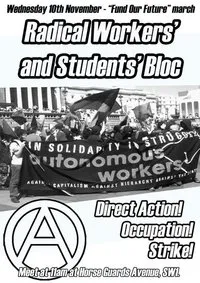
On Wednesday 10th November 2010 the NUS and UCU have organised a demonstration in London in protest against the cuts in education. We are calling on all anarchists and militant workers and students to join us in forming a 'Radical Workers' and Students' Bloc' on the demonstration, arguing for all those in education to fight the cuts based on the principles of solidarity, direct action, and control of our own struggles – not for a struggle controlled by union bureaucrats and political ‘leaders’ who can only go so far.
On Saturday 23rd October 2010 a number of trade unions have called for a march in London to lobby the TUC to fight the cuts. This is the same day as the annual London Anarchist Bookfair and a day when a large number of anarchists are in the city. We are calling on all anarchists and militant workers to join us in forming a 'Radical Worker's Bloc' on the demonstration, not to beg the trade union bureaucrats to take action, but to argue that we fight the cuts based on the principles of solidarity, direct action, and control of our own struggles.
Workers at Metronet, the former London Underground (LUL) engineering contractor, have developed their Strike Committee as a form of rank and file organisation that represents an interesting step beyond the confines of the usual trade union structures. Now that the track contract is back in house, they are rolling this organising model out across the whole of the underground to become the London Underground Strike Committee. Here we look at the background of struggle against which the strike committee has been built up, and the bottom up tactics that have been vital to its successes.
Historically, the RMT’s strength on the underground had been among train drivers and station staff. Engineering workers had been the poor relations, and the union had relied on drivers to win disputes.
The Great Dock Strike of 1889 in London is remembered as the foundation of the modern trade union movement. It was led by social democrats like Ben Tillett and future member of the Liberal cabinet John Burns, and by the future syndicalist and Communist Tom Mann. Its centenary in 1989 was celebrated by the Transport and General Workers’ Union, now part of Unite!, which traced its origins back to the strike. How-ever, for the nascent anarchist movement in Britain it was also a significant event which turned abstract talk of revolution and a simple advocacy of expropriation and rioting into what ultimately became anarcho-syndicalism.
 SolFedNL@riseup.net | twitter.com/nlsolfed | facebook.com/northlondonsf | network23.org/solfednl and find us on radar.squat.net