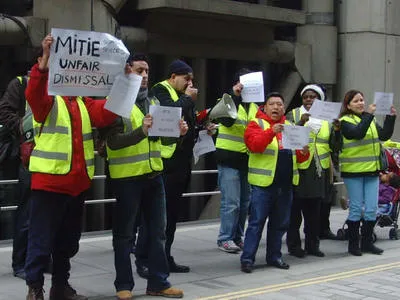
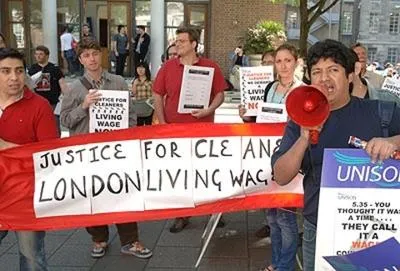
Latin American cleaners on Friday 3rd April held the latest in a series of weekly demonstrations outside their former workplace in the insurance firm Willis in the City of London against the sacking of five of their colleagues by the Mitie cleaning contractor. The four men and one woman were dismissed following an email conversation with management, in which the cleaners registered their unhappiness at a sudden change in shift patterns, done without consultation.
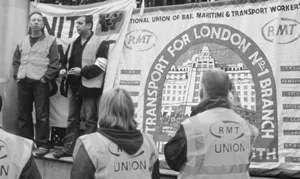
From 7pm on the evening of Tuesday June 9th until 7pm on Thursday June 11th 2009, London Underground workers in the Rail, Maritime and Transport (RMT) union took strike action. The main issue was job security as tube bosses flatly refused to rule out compulsory redundancies, putting 4,000 jobs at risk. London Underground originally also tried to force through a five-year pay agreement which could see significant pay cuts linked to deflation. This, alongside severe management bullying, led the workers to strike.
Members of North London SF demonstrated alongside other militants outside the head offices of London & Regional Properties, owners of Berns Salonger, a company that treats the cleaners it employs with intolerable conditions.
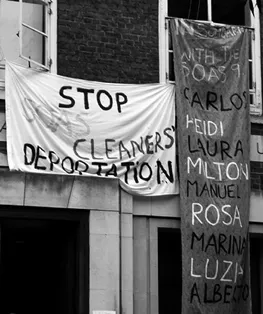
On June 12th, cleaners working for ISS at the School of Oriental & African Studies (SOAS) in London were called to a meeting by management. The cleaners were “processed” by immigration officials who detained nine of them as “illegal immigrants”. It was perhaps no coincidence that a picket of SOAS’ governing body demanding the reinstatement of victimised SOAS UNISON Branch Chair José Stalin Bermudez, who had been prominent in organising cleaners, had been called for that morning.
Those detained were denied union representation, but a campaign was quickly organised by SOAS campus unions and students, migrant worker activists and anti-deportation campaigners. SOAS management was held responsible for ISS “ambushing” their cleaners as punishment for winning union recognition and the London Living Wage.
While the recent media spin is suggesting that we’re ‘on our way out of recession’, the reality on the ground is that workers are still facing attacks across sectors in the forms of job cuts and community provisions. Education has been one of the sectors worst hit in this period, with £65m slashed from higher-education (HE) budgets, schools closing left, right and centre, and jobs to go at approximately 100 of the 150 HE institutions in the UK . The situation is as bleak as ever.
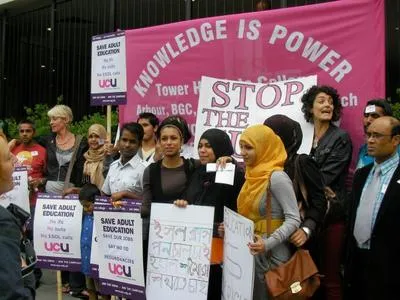
In August, around 250 members of teaching staff at Tower Hamlets College (THC), East London went on indefinite strike over threats of compulsory redundancies, and cuts in provision of ESOL (English for Speakers of Other Languages) courses. Catalyst spoke to Rachel, a member of the striking staff, about the background of the dispute, the issues at hand, and the feelings after the strike came to an end in late September.
Workers in contract cleaning face low wages, a lack of basic employment rights, bullying management and victimisation for union activities. However, especially among Latin Americans, self-organisation has sustained struggles against their unscrupulous multi-national employers, and the fight against the immigration controls which are used to sack unwanted workers and victimise union activists.
 SolFedNL@riseup.net | twitter.com/nlsolfed | facebook.com/northlondonsf | network23.org/solfednl and find us on radar.squat.net