
Home
Solidarity Federation
IWA
User account menu
  • Contact
  • Log in
  • Home
    • Intro
    • Workplace organiser training
    • Industrial strategy
    • Community strategy
    • Constitution
  • SolFed
    • Brighton
    • Bristol
    • Edinburgh
    • Liverpool
    • Manchester
    • North London
    • Wales
    • Yorkshire
  • Industries & sectors
    • Claimants and unpaid
    • Education
    • Health and social care
    • Hospitality
  • Events & reports
  • Publications
    • Guides
      • Stuff your boss (doesn't want you to know)
      • Stuff your sexist boss (doesn't want you to know) (2018)
      • Stuff your landlord (doesn't want you to know) (2016)
      • Is your cleaning job killing you? A guide to cleaners health and safety (2017)
      • Office worker’s health and safety - your rights and how to use them (2015)
      • A migrant's guide to Manchester (2016) [en es]
      • A migrant's guide to London (2014) [en es pl]
      • Strike - a guide to walking out (2014)
    • Pamphlets and books
      • Anarcho-syndicalism in Britain – a little history (2015)
        • 1. 19th century to 1914 - The First International, growth of industrial unionism and the Great Unrest
        • 2. 1914–1945 - State suppression and the Bolshevik turn – how Lenin’s seeming success drew militants to the Comintern
        • 3. 1945–1994 - The Anarchist Federation of Britain, Syndicalist Workers’ Federation and Direct Action Movement
        • 4. Today’s movement - A short look at the strategy and thinking of the modern Solidarity Federation
      • Office worker’s health and safety - your rights and how to use them (2015)
      • Anarchism and Anarcho-syndicalism (Rudolf Rocker, 2014)
        • Introduction
        • 1. Ideology of Anarchism
        • 2. History of anarchist philosphy, from Lao-Tse to Kropotkin
        • 3. The origins of anarcho-syndicalism
        • 4. Socialism and anarcho-syndicalism in France
        • 5. The role of the trade unions: anarcho-syndicalist view
        • 6. The struggle in Germany and Spain
        • 7. The political struggle: anarcho-syndicalist view
        • 8. Anarcho-syndicalism since the First World War
      • Fighting for ourselves - anarcho-syndicalism and the class struggle (2012)
        • Introduction
        • 1. The mainstream workers' movement
        • 2. Radical currents in the workers' movement
        • 3. Anarcho-syndicalism in the 20th century
        • 4. Capitalism and the class struggle since World War II
        • 5. Anarcho-syndicalism in the 21st century
        • Endnotes
      • Workmates - direct action workplace organising on the London underground (2011)
      • The Economics of freedom (2003)
      • A history of anarcho-syndicalism (2001)
      • Out of the frying pan, a critical look at works councils (1998)
      • Health and safety at work - an anarcho-syndicalist approach (1997)
      • Anarcho-syndicalism in Puerto Real (1994)
    • Leaflets and flyers
      • Solidarity Federation Education Union (SFEU)
      • Solidarity Federation Hospitality Workers Union (SFHWU)
      • Why do we organise?
      • This is our flag - it tells you what we stand for
      • What is anarcho-syndicalism anyway?
      • Anarchism and Syndicalism (short version)
      • Anarchism and Syndicalism
      • Towards a better union
      • Protest is not enough
      • Building beyond elections
      • We should run our workplaces
      • We should run our communities
      • We should run our movements
    • Newsletters
      • Brighton Solidarity
        • Brighton Solidarity #3
      • Education Worker
        • Education Worker #10 Victimisation (2013)
        • Education Worker #9 (2012)
        • Education Worker #8 Academy Special (2012)
      • Wildcat!
        • Wildcat! #13 (Jan 2013)
        • Wildcat! (Winter 2012)
        • Wildcat! #6 (Summer 2011)
        • Wildcat! #5 (Spring 2011)
        • Wildcat! #4 (Dec 2010)
        • Wildcat! #3 (Oct-Nov 2010)
        • Wildcat! #2 (Jul-Aug 2010)
        • Wildcat! Football for the fans NOT for fat cats! (Jul 2010)
        • Wildcat! #1 (May-June 2010)
      • May Day Bulletin (Newcastle SolFed, 2014)
    • Direct Action
      • Direct Action #2 (2024)
      • Direct Action #1 (2023)
      • Direct action #47 (Summer 2009)
    • Catalyst
      • Catalyst #29 (Feb 2012)
      • Catalyst #28 (Oct 2011)
      • Catalyst #27 (Jun 2011)
      • Catalyst #26 (Mar 2011)
      • Catalyst #25 (Dec 2010)
      • Catalyst #24 (Summer 2010)
    • SelfEd
      • A history of anarcho-syndicalism
        • Block 1
          • Unit 1: The Origins of Capitalism
          • Unit 2: Britain: The Radical Period 1750-1840
          • Unit 3: The First International
          • Unit 4: France 1870-1918 Early revolutionary unions
          • Unit 5: Revolutionary Syndicalism in Britain, 1870-1910
          • Unit 6: Revolutionary Syndicalism in Britain and Ireland, 1910-17
        • Block 2
          • Unit 7: Mexico 1870-1920: Colonialism and Revolution
          • Unit 8: USA 1886-1930 - The Wobblies
          • Unit 9: Anarcho-syndicalism in Argentina 1870-1939
          • Unit 10: Sweden 1889-1939
          • Unit 11: Russia I: 1850-1917
          • Unit 12 Russia II: 1917-30
        • Block 3
          • Unit 13: Going Global - International Organisation, 1872-1922
          • Unit 14: Anarcho-syndicalism in Britain, 1914-30
          • Unit 15 Spain, 1868-1936: Build-up to Revolution
          • Unit 16 Spain: Culture, education, women and sexuality
          • Unit 17: Spain 1936-39: Revolution and Civil War
          • Unit 18: Spain - The Collectives
        • Block 4
          • Unit 19: Britain, 1930-1950 - The Era of Reform
          • Unit 20: Britain, 1950-1990 - Decline of Social Democracy
          • Unit 21: anarcho-syndicalism 1939-99
          • Unit 22: Roots of modern anarcho-syndicalism: freedom, oppression & rebellion
          • Unit 23: Roots of modern anarcho-syndicalism: morality, culture & tactics
          • Unit 24: The spirit of anarcho-syndicalism
    • Letters
  • IWA

Breadcrumb

  1. Home

pay and conditions

By Choccy, 28 July, 2012
c

Education round up 27 July 2012

(Un)Qualified teachers wanted.
While the eyes of most people, both critical and uncritical, are drawn to the Olympics, secretary of state for Education, Michael Gove, has introduced possibly his most significant and destructive piece of reform.

Academies no longer need to employ qualified teachers to teach lessons. Gove heralds this as 'freedom' for academies to employ 'the best for the job'. So while trying to raise the profile of teaching, he's doing the exact opposite. But this is a smokescreen. This is nothing to do with profile, or improving education, or getting 'the best for the job'. It has everything to do with driving down pay and conditions.
Tags

  • Education Worker
  • schools and academies
  • National Union of Teachers (NUT)
  • education
  • pay and conditions
  • privatisation
By Cobbler, 28 April, 2011

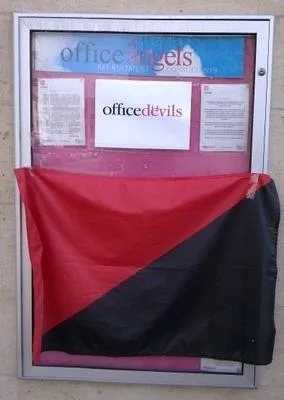
Northampton: Office Angels picket 28th April

Members of Northampton Solidarity Federation today picketed the local office of Office Angels in connection with the current dispute over non payment of wages.

We talked to many passers by about the bad practice and heard several stories of mistreatment at the hands of employment agencies, particularly of underpayment and summary dismissals. One worker in particular related instances where she had worked for long periods of time for agencies only to be laid off for one day's illness.

The office manager came out to see us on two occasions, the first time to ask why we were there and to ask us to remove our flag which was draped over their standing display board (which we taped to their noticeboard instead). On reading the leaflet we were distributing she insisted, not surprisingly, that they always paid their workers. We responded that if that were so, we looked forward to hearing that the person whose non payment triggered this dispute had been paid...

Tags

  • casualisation
  • direct action
  • casework
  • pay and conditions
  • Office Angels
By Joseph Kay, 20 March, 2011

UK news in briefs

Government 'war games' against the working class

The Cabinet Office has reportedly been carrying out ‘war games’ to prepare for possible strike action against sweeping cut backs. Plans have centred on ensuring there’s enough scab labour available to break strikes in key sectors. 

Ministers have already suggested they will tighten Britain’s already draconian anti-strike laws in the event significant strike action breaks out. A string of recent strike ballots have been ruled unlawful in the courts, using technicalities to annul majority votes for action. Both Prime Minister David Cameron and Chancellor George Osborne have threated to further tighten the law “as a last resort” if union bosses don’t co-operate.

Merseyside protest at planned plant closure

Workers and supporters at the Burton’s biscuits factory in Moreton have marched against plans to close the plant.

Tags

  • health and safety
  • asbestos
  • homelessness
  • squatting
  • NHS
  • pay and conditions
By no1, 24 October, 2010

“More (crap) Jobs than Ever” ... Tony Blair claims...

The Labour Government repeatedly claims that there are more people in work than ever. “This year, for the first time, there are more than 30 million in the workforce” boasted Gordon Brown recently. But sadly, there.s more to it.

On the face of it, Labour.s record on employment is good. According to the International Labour Organisation, unemployment in Britain stands at 4.8%, not bad when compared with the Eurozone.s 9%. But, as always with Labour, the devil is in the detail.

Tags

  • pay and conditions
By sifa, 23 October, 2010

Service not included

Following our piece on tips in the last issue, The Independent launched a campaign on the same issue. They didn’t credit either us or the trades unions, which have been campaigning on the issue much longer.

This newspaper campaign seems to have had some effect, however. “Government insiders” now claim they will address the issue in the autumn. More significantly, a prominent “Old” Labour figure has admitted delivering restaurant workers into the hands of their exploiters when drafting minimum wage legislation in 1997.

Ian McCartney, ex-trades union official and token ex-prole in the government, admitted that he sold out workers to ensure the agreement of bosses to the minimum wage. While this ex-waiter banned the use of cash tips to top up the minimum wage, he agreed to a legal loophole allowing catering bosses to use “service charges” for the same purpose.

Tags

  • bars, catering, hotels and restaurants
  • pay and conditions
  • employment rights
By Joseph Kay, 23 October, 2010

Service not included

Following our piece on tips in the last issue, The Independent launched a campaign on the same issue. They didn’t credit either us or the trades unions, which have been campaigning on the issue much longer.

This newspaper campaign seems to have had some effect, however. “Government insiders” now claim they will address the issue in the autumn. More significantly, a prominent “Old” Labour figure has admitted delivering restaurant workers into the hands of their exploiters when drafting minimum wage legislation in 1997.

Ian McCartney, ex-trades union official and token ex-prole in the government, admitted that he sold out workers to ensure the agreement of bosses to the minimum wage. While this ex-waiter banned the use of cash tips to top up the minimum wage, he agreed to a legal loophole allowing catering bosses to use “service charges” for the same purpose.

Tags

  • casualisation
  • bars, catering, hotels and restaurants
  • pay and conditions
  • employment rights
By Joseph Kay, 23 October, 2010

Cleaning up on the tube

London tube cleaners have won crucial pay increases from cleaning companies, with their £5.50 an hour poverty wages being brought up to £7.45.

Cleaners on Metronet contracts were granted the ‘ London living wage’ in July through a wider initiative whilst those working for ISS (contracted by Tubelines) won a staggered pay rise in pre-strike negotiations in August.

With the 48hour RMT strike in June/July and the planned three day strike in August forcing the hand of ISS, the cleaners have demonstrated their strength and gained from it. However, their fight is far from over with the strike committee continuing to meet in pursuit of unmet demands - more holidays, better sick pay, a decent pension and an end to the scandal of ‘third party sackings’.

Tags

  • National Union of Rail, Maritime and Transport Workers (RMT)
  • tube
  • cleaning and facilities
  • pay and conditions
  • transport, couriers and drivers
By Joseph Kay, 22 October, 2010

The real cost of inflation

If the government were to announce that it was cutting the wages of all workers there would be uproar. Yet this is exactly what they have done by calling for ‘pay restraint’ and capping all wage rises at 2%. A below-inflation pay ‘rise’ is a pay cut. No amount of statistical trickery changes this fact.

The government’s favoured measure of inflation, the Consumer Price Index (CPI) is currently running around 3.3%. However, this excludes mortgage repayments. Does that mean we don’t have to pay them back out of our falling wages? No such luck. The inflation measure that does include these payments is called the Retail Price Index (RPI). It is currently running at around 4.3%. So by the government’s own figures they are imposing a pay cut of over 2%.

Tags

  • pay and conditions
  • economy
By no1, 26 September, 2010

Have your say: Single Status

Dear DA,

As if the credit crunch wasn’t bad enough, many of us employed in local authorities are now also reeling from the effects of “Single Status” implementation.

The 1997 Single Status agreement between employers and public service unions called for a pay and grading review of all local government posts. Many were conned into believing it would give a fairer pay structure within and across local councils. Indeed, at the time, the union bosses told us that “many will gain and nobody will lose”.

Tags

  • letters
  • local government
  • pay and conditions
By no1, 20 September, 2010

Will the CWU deliver?

In spite of the withdrawal of the Labour government’s plans to privatise the Royal Mail, postal workers’ campaign of strike action continues. In truth, postal workers consider privatisation has already happened, when the profitable parts of the business were hived off in the 2006 “liberalisation” exacerbating the problems the Royal Mail faces. The dispute is about “modernisation” – job cuts, attacks on pay, conditions and pensions – and the bullying which has passed for management in the Post for many years. CWU members believe that management are seeking to break the union.

Tags

  • Communication Workers Union (CWU)
  • pay and conditions
  • privatisation
  • Royal Mail

Pagination

  • First page
  • Previous page
  • Page 1
  • Page 2
  • Page 3
  • Next page
  • Last page
pay and conditions

Guides

Your rights at work

Why do we organise? Capitalism is shit, oppression is shit - but what can we at SolFed do about it?

Why do we organise?

This is our flag - it tells you what we stand for

this-is-our-flag

Direct Action #2 (2024)

Direct Action #2 (2024)

Anarcho-syndicalism in Britain – a little history (2015)

Anarcho-syndicalism in Britain – a little history (2015)

Office worker’s health and safety - your rights and how to use them (2015)

Office worker’s health and safety - your rights and how to use them (2015)

Anarchism and Anarcho-syndicalism (Rudolf Rocker, 2014)

Anarchism and Anarcho-syndicalism (Rudolf Rocker, 2014)

Fighting for ourselves - anarcho-syndicalism and the class struggle (2012)

Fighting for ourselves - anarcho-syndicalism and the class struggle (2012)

Theory & Practice 1 - Workmates - direct action workplace organising on the London underground (2011)

Theory & Practice 1 - Workmates - direct action workplace organising on the London underground (2011)

The Economics of freedom (2003)

The Economics of freedom (2003)

A history of anarcho-syndicalism (SelfEd Collective, 24 unit series, 2001)

A history of anarcho-syndicalism (SelfEd Collective, 24 unit series, 2001)

Out of the frying pan, a critical look at works councils (1998)

Out of the frying pan, a critical look at works councils (1998)

Health and safety at work - an anarcho-syndicalist approach (1997)

Health and safety at work - an anarcho-syndicalist approach (1997)

Theory & Practice 2 - Anarcho-syndicalism in Puerto Real (1994)

Theory & Practice 2 - Anarcho-syndicalism in Puerto Real (1994)
RSS feed