“The pay and terms of conditions of employment for over 1.4 million local government services workers is determined by the National Joint Council (NJC) for Local Government Services.” So reads the local government website and herein lie the constraints that trade unionists have to fight against.
The National Joint Council (NJC, see the 'green book') is for pay and conditions negotiations for local government workers in England, Wales and Northern Ireland. The Scottish Joint Council (SJC, see the 'red book') is for negotiations for local government workers in the thirty-two local authorities/councils across Scotland. Our small union, the Solidarity Federation Education Union (SFEU) is not part of the NJC or SJC but our members are active on the ground and in the workplace fighting for better pay and conditions every day.
Cardiff, Durham, Hertfordshire, Sheffield... the list of struggling HEIs goes on and on. If anything was clear as this stage, it's that the funding model for Higher Education is simply not working. Like most of capitalist or quasi-capitalist ventures, leaving everything to the market is not only wasteful but is also extremely damaging of workers' livelihoods. Young people and others who wish to embark on a University course are increasingly thinking twice about doing so because of mounting costs, often questionable quality as provision is cut to the bone and a future that is as doubtful as the
No-one will doubt that Higher Education is undergoing one of its historic, but it has to be acknowledged, repeated crises. With a drop in international students by some 16% and with approximately 40% of HEIs (Higher Education Institutions) thought to be likely to go into deficit in 2025-2026, university management teams are cutting universities to the bone. Departments supposedly under review face rapid closure or down-sizing, staff in academic support roles have had their positions slashed and whole programmes are disappearing.
In the past, here at SFEU we have highlighted how the (literally)
The concept of marketisation must have seemed a good idea to someone at some point. It’s a shame that it has fallen to higher education to prove the idiocy of capitalism.
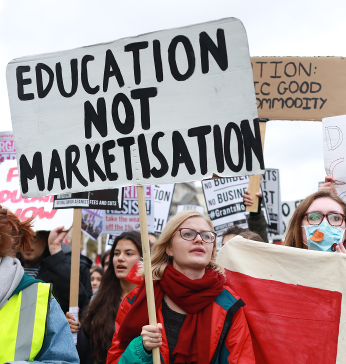
Education is not a commodity to be thrown to the winds of market forces, it is a basic right and should be properly funded and supported.
Instead, we saw fees jump to £9,000 a year in 2012, followed in 2015 by the lifting of the cap on how many students a university could recruit. The ‘survival of the fittest’ rationale was blatant - good universities would do well and bad universities would close. This is way too simplistic
As many higher education institutions are on the brink of financial collapse, it’s time to understand what has brought about this perfect storm and what can be done about it.
Headlines often focus on ‘over-reliance on international students’ but it is more complex than that. Why do you think universities try so hard to recruit international students?... because their fees are not regulated, and universities can charge what they think they can get away with given market forces; i.e. Cambridge can charge a student from China more than Cardiff Met can.
The assault against Higher Education provision in the UK continues apace. In particular, those subjects that are deemed too expensive or that don't force graduates down the narrow road of making money for money's sake - these are the ones suffering an onslaught as departments and units are downsized or closed. The humanities, modern languages and the arts in general, continue to face obliteration. Oxford Brookes, Aberdeen, Lincoln are just some of the universities where these subjects are being eliminated or significantly reduced. Staff are being laid off. Students' futures are being mortgaged
The Solidarity Federation Education Union (SFEU) would like to express its heartfelt thanks for the support shown by students at recent graduation ceremonies. The Marking and Assessment Boycott (MAB) has been a difficult time for both staff and students, but it is clear that we stand in solidarity together against those institutions that would rather penalise its workers than negotiate with them.
At some institutions, the MAB has had such a huge impact that graduation and classification of degrees has been severely affected. These huge sacrifices in terms of both pay and of grades demonstrate
In late 2022, the GMB, Unite and Unison issued a formal complaint to the TUC against the NEU alleging that “the NEU had actively sought to recruit school support staff and had intervened in pay negotiations between the three recognised unions and the local government employers, which cover school support staff.”
Members of the GMB, Unite and Unison responded, unsuccessfully, with a petition calling for a withdrawal of the complaint. The claim was in response to a prior agreement made between all four unions that the NEU should not “recruit nor organise in areas already covered by other
As the number of management teams at Universities across the country show their willingness to re-open negotiations in order to limit the damage of the Marking and Assessment Boycott (MAB) currently underway, there are some institutions that continue to threaten 100% reductions for "partial performance" of work. In the past, this kind of employer's lockout, when bosses refuse to pay you for any work done, has been upheld by the courts. Here at SFEU, the anarcho-syndicalist union in education, we would be surprised if the courts would act any differently - the courts do not reflect our
 “The pay and terms of conditions of employment for over 1.4 million local government services workers is determined by the National Joint Council (NJC) for Local Government Services.” So reads the local government
 As many higher education institutions are on the brink of financial collapse, it’s time to understand what has brought about this perfect storm and what can be done about it.