Workers opposed to privatisation at the university of Sussex decided to ballot for industrial action after uni bosses refused to stop the ongoing outsourcing process. The move comes less than three weeks after the Pop-Up Union, an unconventional rank-and-file initiative, became officially listed as a trade union.
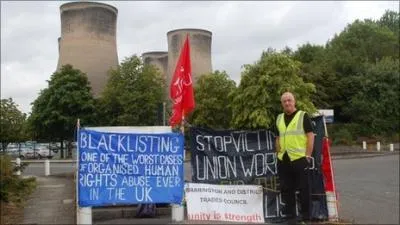
A meeting of the Merseyside Blacklist Support Group took place last Saturday (February 23rd). The event was attended by numerous blacklisted construction workers and addressed by a panel of speakers including Steve Acheson, a blacklisted electrician from Manchester who has been picketing the Fiddler’s Ferry power station for the last 5 years to highlight the injustice inflicted on him.
Steve spoke about the collusion between trade union officials and construction companies that led to him and countless others being denied employment due to their trade union activities (often simply raising health and safety concerns on sites). Steve said he had only three terms of employment over a nine-year period and had been removed from all of them as a result of being blacklisted.
In September 2012, TUC Congress overwhelmingly passed a resolution calling for co-ordinated national action, up to and including a general strike.
As the first step towards putting this motion into effect, a conference took place in Liverpool on 26th January organised by Merseyside Association of Trades Union Councils. Tellingly, the conference received no funding at all from the North-West TUC.
Members of our SolFed local attended, with the aim of engaging with rank-and-file trade unionists and arguing in favour of working-class self-organisation and direct action against austerity. We distributed a leaflet which read:
Farm workers in South Africa are currently on strike to demand higher wages and the right to organise in the face of a programme of suppression and intimidation by the predominantly white farm owners and in defiance of the political and Trade Union establishment.
A SolFed member who has worked as an electrician since the late 1970s shares his experience of the electric supply industry, privatisation and trade unions.
I started an apprenticeship at 16 from school in the local electric company. It was then a nationalised industry and everyone was in one of the recognised (by the company) trade unions (a closed shop). There were many different departments and staff could move between them as workload dictated. As an apprentice I spent time in each department to give me experience of each and to hopefully decide in which one I would ultimately stay.
There were problems with management as in all workplaces (still very much us and them), there was also a great divide between office staff and the industrial staff (we never mixed). I think that was due to the fact that they (the office staff) would work as normal when we were in dispute and their wages and pensions were far more generous.
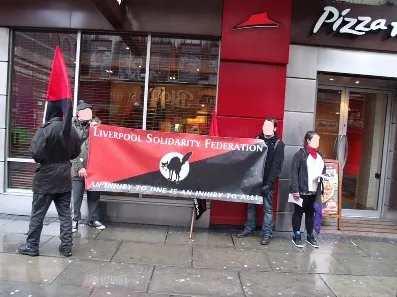
Today, members of Liverpool Solidarity Federation held a picket outside two branches of Pizza Hut in Liverpool City Centre. This was in solidarity with members of the Pizza Hut Workers’ Union (part of the IWW) in Sheffield who had called for a nationwide day of action against the company as part of their ongoing dispute with Pizza Hut management over pay, conditions and union recognition.
The demands are stated by the union membership as follows:
“In drivers conditions we are demanding regular updates of all moped drivers safety gear. We are also demanding an increase to deliver drivers per-delivery commission, which now stands at 60p, which clearly does not cover costs.
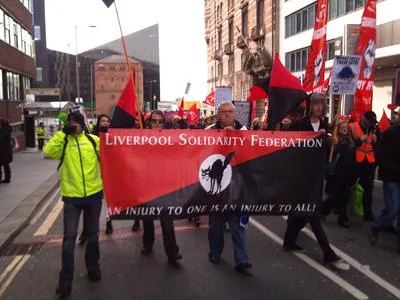
Yesterday, Liverpool Solidarity Federation members joined picket lines in Liverpool and Bootle to offer support to strikers and attended a 20,000-strong march through the City Centre. Below are several personal reports from members' blogs.
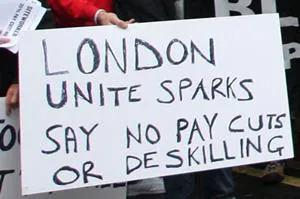
Earlier this year the ‘Big 8’ major construction employers announced plans to tear up an industry agreement on pay, grading and seniority which would result in pay cuts of up to 35%. Workers, not trusting the Unite union to act in their interests, organised themselves into ‘Sparks’, an independent rank-and-file electricians’ group run by a committee elected from their ranks. Their scepticism towards the trade union structures appeared to be vindicated when Unite official Bernard McAulay described Sparks as “cancerous” in a leaked email.
The trade unions have worked hard over the last twenty years to shed their cloth cap image. Notions of class struggle, with the unions as the means of organising that struggle, have been dropped as unbefitting the modern era. The focal point of today’s movement is no longer the workplace but the union head or regional offices. Housed in modern buildings and staffed by professionals, able to offer the best possible service to managers and workers alike, these offices stand as the physical embodiment of all that is ‘best’ about 21st century trade unions.
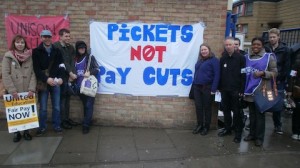 All entrances to the large Mile End campus were picketed by members of the participating unions, UNISON, UCU and UNITE, from 7am.